


Nonlinear System Identification of Mechanical Joints
Funded by a grant from Sandia National Laboratory
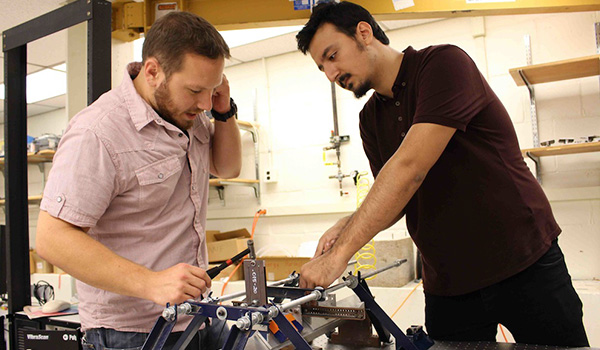
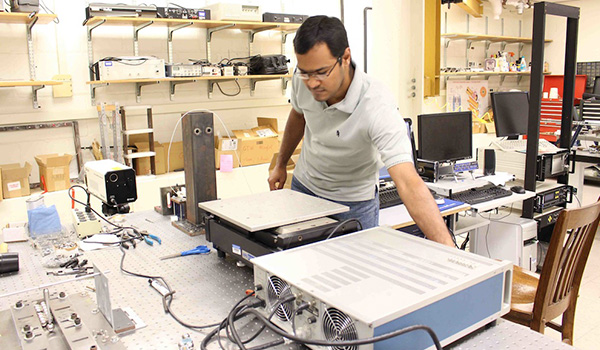
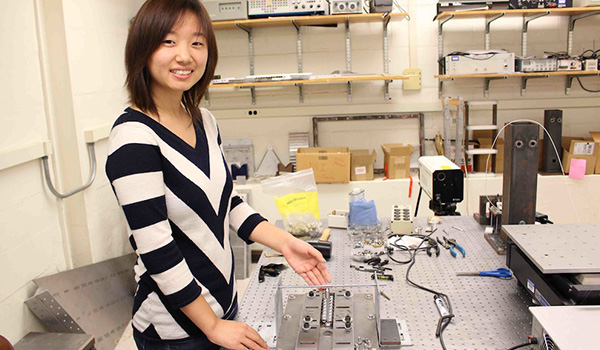
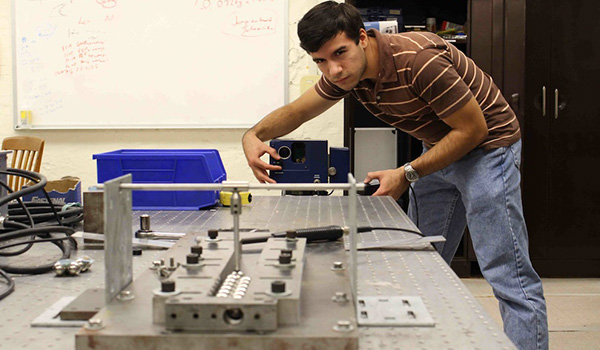
We apply a nonlinear system identification (NSI) methodology to identify the nonlinear characteristics of mechanical joints. The methodology relies on direct post processing of measured time series. It combines Wavelet transforms and Empirical Mode Decompositions with Complexification-Averaging Analysis, and leads to reduced slow flow reduced models. The project will combine the NSI methodology with methods for model reduction via distributed damping developed by researchers in Sandia National Laboratory, and will have a significant experimental component.
Global/Local System Identification of Strongly Nonlinear Dynamical Systems
Funded by an NSF EPSCoR Research Grant (in collaboration with New Mexico State University)
This work is performed in colloboration with Professor Young Sup Lee (New Mexico University)
Design of Adaptive Load Mitigating Materials Using Nonlinear Stress Wave Tailoring
Funded by an ARO MURI Grant (in collaboration with the California Institute of Technology)
This research aims to develop a new class of structured protective systems, primarily based on materials incorporating inhomogeneous granular media, phase transforming ceramics and novel geopolymers. In the process we plan to study theoretically and experimentally scalable nonlinear interactions within these layered media. More specifically, we plan to employ granular media as a basis for a new class of nonlinearly adaptive, discontinuous, highly inhomogeneous materials capable of stress wave tailoring, passive and adaptive energy confinement, and energy redirection in preferential directions within the material compatible with the design objectives. This project involves fundamental work to understand both experimentally and analytically nonlinear energy transfer phenomena induced by intentional strong nonlinearities in a material. In addition, we aim to transfer these fundamental concepts to actual material systems with demonstrated stress wave tailoring properties. Specific objectives include, (i) to further the understanding of the role of essentially nonlinear contact phenomena in wave propagation in discretely inhomogeneous systems, and to transfer these fundamental concepts into an actual scalable material system; (ii) to develop a theoretical/computational framework for the design of a material system or material system classes, that will exhibit adaptive stress wave mitigation characteristics; and (iii) to experimentally demonstrate the stress wave management characteristics of the conceptual material system designs.
This work is performed in colloboration with Professor Chaira Daraio (California Institute of Technology).
Structural Logic: Tailoring stiffness and damping of large scale structures via passive nonlinear targeted energy transfer
Funded by a DARPA Phase I Research Grant (in collaboration with the University of Akron)
We aim to exploit intentional strong nonlinearities introduced at optimal locations within a structure of interest in order to promote fully passive adaptivity of the structural dynamics to changing loads. This will be accomplished through the implementation of passive nonlinear energy sinks – NESs – with essential (non-linearizable) stiffness and damping nonlinearities at selected points of the structure acting, in essence, as passive broadband rapid dissipaters of vibration and shock energy. Hence, the NESs will not only drastically increase the effective damping of the structure but will also introduce effective stiffening into the structural response. The basic rationale behind the proposed designs is that the implementation of local NESs will passively modify the global structural dynamics of the modified system by, (i) introducing new sets of essentially nonlinear structural modes in specific frequency ranges of interest that, in effect, either increase or decrease the structural compliance; (ii) drastically increasing the effective damping of the structure, through targeted energy transfer – TET – from the structure to the NESs where it is rapidly dissipated locally; and (iii) enabling the structure to passively adapt its dynamics to a broad range of applied excitations over extended frequency and energy ranges. Key to our proposed design is the implementation of modular NESs with nonlinearizable (essentially nonlinear) stiffness characteristics, having no preferential resonance frequencies and thus, the capacity to engage in resonance interactions with sets of structural modes through resonance capture cascades. Indeed, the NESs will have the capacity to extract and locally dissipate vibration and shock energy from highly energetic structural modes in a broadband multifrequency fashion through TET. Furthermore, we will propose the implementation of NESs with geometrically nonlinear damping, which will be designed to drastically enhance the capacity of these local attachments to robustly absorb and rapidly dissipate vibration energy over broad frequency and energy ranges, thus increasing the effective damping factor of the structure. We emphasize that the proposed designs are fundamentally different than usual linear designs, e.g., linear vibration absorbers, that are narrowband in operation and not adaptable to change in forcing conditions. To highlight this difference, we mention that the addition of a local linear vibration absorber will introduce only a local modification in the frequency response of the structure, and it will be incapable of differentiating between different energy levels of the excitation. On the contrary, the proposed NESs are broadband devices which, although local, have the capacity not only to inflict global changes in the frequency response of the structure, but also to passively adapt their operation to excitations with varying energy and frequency content. Hence, the proposed designs will be efficacious under a wide range of loading scenarios, with robust performance under parametric and loading uncertainties.
This work is performed in colloboration with Professor Donald D. Quinn (University of Akron).
Nonlinear Dynamics of Oscillators Exhibiting Targeted Energy Transfers
Funded by a Binational Science Foundation (BSF) Grant (in collaboration with Technion – Israel Institute of Technology)
The methods applied in this work evolved over nine years of collaborative work between the Israeli and US groups, through visits, joint publications and coordinated research efforts. The main idea is to connect to a linear system an essentially nonlinear attachment that acts as nonlinear energy sink (NES) of unwanted vibrations. Properly designed NESs can passively absorb broadband or narrowband energy from linear systems through a series of transient resonance captures (TRCs), i.e., transient nonlinear resonances of the NES with linear modes during which targeted energy transfer (TET) occurs from the mode to the NES, after which the NES engages the next mode of the sequence. This unique feature of the NES is due to the fact that it lacks a preferential resonant frequency, so it can engage in resonance with modes over broad frequency ranges. The goal of this project is to extend the state-of-the-art of the theory of TET through the following research thrusts: (i) Theoretical and experimental study of the dynamics of multi-degree-of-freedom and continuous (elastic) systems with attached NESs and optimization studies of TET in these systems leading to efficient implementation of this concept to practical applications; and (ii) theoretical and experimental study of a new NES design based of strongly nonlinear inertial effects, and application of the new design to practical problems, such as aeroelastic flutter suppression and seismic mitigation.
This work is in colloboration with Professor Oleg Gendelman (Technion).
Intrinsically-Nonlinear Broadband Nanoresonator for Ultrahighly Sensitive Sensing of Energy Transfers
Funded by an NSF Research Grant
Much of the study on mechanical nanoresonators has focused on improving their Q factor, realizing their high frequency operation and reducing their size. The idea is that with the combination of small effective mass, low damping and up to GHz resonance frequency, such nanoresonators can achieve ultrahigh sensitivity to force and mass changes. Indeed, in the last couple of years, significant progress towards that end has been witnessed, where single-atom level mass sensitivity has been demonstrated with the use of nanoscale mechanical resonator. This impressive sensitivity, however, can not be maintained when such nanoresonators would be operated in an energy dissipative environment, such as in an ambient environment, where the hydrodynamic damping in air is significant. The underlying notion is that as the energy dissipation involved in the resonance system increases, the Q factor decreases and so does the sensitivity. This notion, however, is perceived from the understanding that the nanoresonator has to be operated in the linear dynamic regime at its fundamental resonance frequency. In this research, we aim to advance a paradigm-shifting concept in micro-/nano-resonator design and development that involves the simple substitution of an essential geometric nonlinearity in an otherwise linear resonant system to realize an intrinsically nonlinear broadband resonator, meaning that the resonator has no preferential resonant frequency and is nonlinear at any oscillation amplitude and across the whole frequency spectrum. The nonlinearity associated with the system prescribes that this nonlinear resonator is most sensitive to the change in energy transfer. The reduced size, down to micro-/nano-scale, significantly reduces the overall system energy associated with such a nonlinear resonant system, this in turn makes it sensitive to even the slightest amount of energy transfer between the resonator and the involved environment. While the sensitivity of a linear resonant system deteriorates when operated in an energy dissipative environment, a nonlinear resonant system, especially a micro-/nano-scale one, can actually be highly alert to such energy dissipation and thus sense any changes within the system including the environment with high sensitivity. We aim to make this paradigm shift from sensing mass change with a linear resonant system to sensing energy transfer with this kind of nonlinear nanoscale resonant system and propose to exploit the instabilities associated with such an essentially nonlinear resonator to achieve highly sensitive sensing in both ambient and vacuum environments.
This work is performed in collaboration with Professor Min-Feng Yu of the University of Illinois.
Collaborative Research: Nonlinear Design and Development of Multi Degree-of-freedom Broadband Energy Harvesting Systems
Funded by an NSF research grant
This work addresses the harvesting and conversion of mechanical energy from low-level ambient vibration into usable electrical energy. The development of a self-renewing source of energy is paramount to the continued development of such devices such as portable electronics and wireless sensors, and the ability to convert ambient mechanical energy to usable electrical energy fills these requirements. However, to achieve acceptable performance conventional vibration-driven energy harvesting devices based on linear elements must be specifically tuned to match environmental conditions such as the frequency and amplitude of the external vibration. As the environmental conditions vary under ambient conditions the performance of these linear devices is dramatically decreased. The strategy to efficiently harvest energy from low-level, intermittent ambient vibration, proposed herein, relies on unique properties of strongly nonlinear vibrating systems that are referred to as “essentially” nonlinear. Utilizing this technology, we propose to develop multi degree-of-freedom, passive, broadband devices that will increase the efficiency and performance of energy harvesting systems to the low-level ambient vibrations. Furthermore, we will collaborate with a group at the University of Bristol (UK) to systems incorporate state of the art energy conversion strategies that work efficiently in conjunction with the broadband resonator to produce a reliable, consistent source of power. Finally, we will design and develop several breadboard systems, culminating in demonstratable hardware. We anticipate that this work can have broad impact as an enabling technology for the next-generation portable devices and wireless sensors. By increasing the power available to such components, device limitations associated with the power supply can be reduced or even possibly eliminated. In addition, this research will provide a novel framework for the design and optimization of systems that intentionally incorporate nonlinear elements. Finally, this project will enhance the diversity of the engineering community through targeted outreach, undergraduate research programs, and the support of students from underrepresented groups.
This work is performed in collaboration with Professor Donald D. Quinn of the University of Akron.
Nonlinear Targeted Energy Transfer for Enhanced Passive Seismic Mitigation of Structures
Funded by University of Illinois Research Funds and the W. Grafton and Lillian B. Wilkins Endowed Professorship (in collaboration with University of Reggio Calabria)
The aim of this work is to show that is possible to apply the Nonlinear Energy Sink (NES) concept to protect full scale seismically excited steel structures through Targeted Energy Transfer (TET). We consider, as primary (linear) systems, multi-storey shear frames with beams sufficiently rigid so that the frames can reasonably be considered as shear-type. To a frame, we connect one or more NESs which can be both smooth or non-smooth, that is can have smooth or non-smooth essential stiffness nonlinearities. Of particular interest are NESs with vibro-impact characteristics. Attaching NESs to a structure brings two advantages as far as seismic mitigation design is concerned. First, the vibro-impact NES, through its fast reaction time during the crucial initial few cycles of the seismic motion, ensures a reduction of the initial high peaks of the structural response; in addition the vibro-impacts scatter seismic energy from low to high structural modes, which leads to a high-frequency redistribution of seismic energy that lower the response amplitudes and is favorable to dissipation of seismic energy by internal structural damping . Second, the smooth NES can ensure vibration control of the structural motion during the second and later stage of the response. In addition, the smooth NES is an effective passive vibration boundary controller in cases of earthquakes of modest intensity. Computational and experimental studies are performed.
Simple Mechanical Oscillators in the Macroscale that Exhibit a Quantum Effect
Funded by University of Illinois Research Funds and the W. Grafton and Lillian B. Wilkins Endowed Professorship (in collaboration with the Institute of Chemical Physics, Russian Academy of Science)
This work is performed in collaboration with Professor Leonid I. Manevitch (Institute of Chemical Physics, Russian Academy of Science).
Suppression of Vortex Shedding Vibrations by Passive Nonlinear Energy Transfer
Funded by University of Illinois Research Funds and the W. Grafton and Lillian B. Wilkins Endowed Professorship
We study the problem of suppressing flow-induced instabilities (limit cycle oscillations – LCOs) of the in-flow oscillations of a cylinder resting on a viscoelastic foundation. Our work is based on high-fidelity 3-dim codes of the flow-structure interaction. We have validated the code with results available in the literature, and we are studying the effect on the vortex shedding dynamics of an internal nonlinear energy sink (NES) in the cylinder. We study targeted energy transfer from the flow and the cylinder to the NES, and use reduced order modeling and asymptotic analysis to investigate the possible mechanisms for passive vortex shedding suppression due to the action of the NES, as well as the robustness of this suppression. We envision important applications in the fields of stabilization of pylons in sea platforms, monitoring of corrosion-induced instabilities in nuclear fuel rods, and other applications involving flow-induced instabilities in structures.
This work is performed in collaboration with Professors Arif Masud and Arne Pearlstein (University of Illinois at Urbana-Champaign).
